Writers and Other Contrinutors Welcome


The Editor of this blog invites other contributors of lead articles, art and poetry etc. Photos welcome. Subject to approval of content etc. While editorially this is a left wing blog with a radical perspective, other opinion is of course welcome to the comments section. Everything being subject to moderator approval of approptiateness to this site.

Saturday, February 10, 2007


More BC Rivers and Streams for Which There Are Private Power Generating Facility Applications.


Watch here daily for rivers and streams in your community district for which there are applications and intentions to build private power generating facilities. The betrayal of the public's interest and right to know continues on the part of the Gordon Campbell Lieberal Government.

Licence No. Stream Name Quantity Licensee

Caribou Water District:

Z121410 Stikine River 50,000ft/sec Cloudworks Energy

Z121922 Sphaler Cr. Not disclosed Cloudwords Energy

C115940 Cacoohtin Cr. 32 Colin McMillan

Z116576 Morehead Cr. 3 Morehead Valley Hydro

Z120544 Atnarko River 16.7 Central Coast Power Corp

Z120809 Noosgulch River 360.06 “ “ “

Z121239 Iskesumkah Lake 65.0 445026 BC Ltd.

Z121240 Nascall Lake 65 “ “ “

Fernie Water District:

C119823 Bull River 1063 BC Hydro & Power

F120603 Elk River 900 BC Hydro & Power

F120650 Bull River 351 BC Hydro & Power

Grand Forks Water District

C104343 Kettle River 3178 Powerhouse Developments

Golden Water District

F120903 Spilimacheen River 300 BC Hydro & Power

Z117624 Kicking Horse River not disclosed Terreton Hydro Corp

Z120871 Blaeberry River 1765.73 Remote Structures Inc

Z121020 Cedar Cr. 3.0 R. Peter Smith

Hazelton Water District

Z117152 Fulton River 240 Dept of Fisheries & Oceans

Z117972 Sedan Cr. 160 Mark Starlund

Z119099 Chimdemash Cr. 5.2 574768 BC Lrd.

Z119103 Kleanza Cr. 353.4 574768 BC Ltd.

Z122169 Boulder Cr. Not disclosed Kingston Assoc Consulting

Kamloops Water District

C117434 Serpentine Cr. 141 ft/sec Valisa Energy

C117823 Whitewater Cr. 12.4 Flett Forestry Ltd.

Whitewater Cr. (storage) 6.5 “ “ “

Z117077 Adolph Cr. 98.9 Hydromax Energy Ltd

Z117078 Allan Cr. 151.9 “ “ “

Z117286 Victor Cr 2000 Canadian Hydro Developers

Z119134 Bone Cr. n/disc “ “

Z119135 Clemina Cr. n/disc “ “

Z119136 Finn Cr. n/disc “ “

Z119137 Gum Cr. n/disc “ “

Z119138 Hellroar Cr. n/disc “ “

Z120678 White River n/disc “ “

Z120679 Moonbeam Cr. n/disc “ “

Z120681 Dominion Cr n/disc “ “

Z121007 Crazy Cr. n/disc “ “


Homeless family in the 1930s


US Federal Reserve Chairman Issues Warning on Social Inequality
By David Walsh
8 February 2007

(Posted with the permission of the World Socialist Web Site.)

In a speech to the Greater Omaha Chamber of Commerce Tuesday, Federal Reserve Chairman Ben Bernanke, America’s central banker and one of the most powerful figures in the country, became the latest member of the US establishment to issue a caution about the growth of social inequality.

In his comments, Bernanke identified an obvious social reality and attempted, at the same time, to conceal both the true dimensions and causes of inequality in the US. Nevertheless, his remarks possess a certain political significance. A growing nervousness exists within the ruling elite about the consequences of a quarter century of its own policies, which have created extraordinary levels of social polarization. Sooner or later, such prominent figures recognize, this will have explosive consequences.

The federal reserve chairman’s comments broke no new ground. On the contrary, he repeated all the nostrums that the American elite repeats to itself and those who will listen about the essentially sound state of the US economy and the benefits it bestows on nearly everyone.

Bernanke began by paying tribute to what he claimed was a “bedrock American principle,” that “all individuals should have the opportunity to succeed on the basis of their own effort, skill, and ingenuity. Equality of economic opportunity appeals to our sense of fairness, certainly, but it also strengthens our economy. If each person is free to develop and apply his or her talents to the greatest extent possible, then both the individual and the economy benefit.”

He quickly added, however, “Although we Americans strive to provide equality of economic opportunity, we do not guarantee equality of economic outcomes, nor should we. Indeed, without the possibility of unequal outcomes tied to differences in effort and skill, the economic incentive for productive behavior would be eliminated, and our market-based economy—which encourages productive activity primarily through the promise of financial reward—would function far less effectively.”

This is the standard argument offered by apologists for capitalism—that inequality is good because the pursuit of financial gain is the only motivation that drives individual and social progress.

Bernanke then changed direction again, adding, “we also believe that no one should be allowed to slip too far down the economic ladder, especially for reasons beyond his or her control.”

After paying tribute to the supposed flexibility and adaptability of America’s “market economy,” Bernanke touched on his central political theme, that the economy’s “very dynamism sometimes creates painful dislocations, as when a shift in consumer demand, the advent of new technology, or new competition leads to the closing of a factory or causes a worker’s skills to become obsolete. If we did not place some limits on the downside risks to individuals affected by economic change, the public at large might become less willing to accept the dynamism that is so essential to economic progress .” [Emphasis added]

In extremely muted and diplomatic language, this was a warning about the possibility of social upheaval. Throughout his speech, Bernanke, as he did in an address last August on globalization, associated opposition to inequality only with Luddite resistance to a ‘more open’ economy and its global integration.

What the fed chairman proposed in his Omaha speech was modest indeed, merely that “people should receive some insurance against the most adverse economic outcomes, especially those arising from events largely outside the person’s control.”

He asserted that while “the average standard of living in this country has improved considerably over time . . . by many measures, inequality in economic outcomes has increased over time as well, albeit at varying rates.”

Bernanke proceeded to discuss some of the figures on social inequality in the US.

He noted that wages at the 50th percentile (“the median wage”) had risen approximately 11.5 percent between 1979 and 2006, while wages at the 10th percentile (“near the bottom of the wage distribution”) had climbed just 4 percent and earnings at the 90th percentile (“close to the top of the distribution”) had jumped 34 percent. Bernanke pointed out that the worker at the 90th percentile now earned 4.7 times as much as the worker at the 10th percentile, compared to a ratio of 3.7 in 1979.

The federal reserve chairman went on to say that greater inequality was also evident in other measures of financial well-being, such as real household income. Figures showed, he said, that the share of the national income received by households in the top fifth of the income distribution rose from 42 percent in 1979 to 50 percent in 2004 (a 19 percent increase), while the share of the bottom 20 percent of households had declined from 7 to 5 percent (a 29 percent decline). He took note of the fact that the wealthiest 1 percent of households had seen its share of after-tax income increase from 8 percent in 1979 to 14 percent in 2004 (a 57 percent jump).

Except in regard to this last figure, Bernanke chose not to mention the extent to which enhanced wealth and social position has accrued not primarily to the top 20, 10 or even 5 percent, but, above all, to the richest 1 percent, and within that, to the top 0.1 percent of the population (about 300,000 people), a group that now receives some 9 percent of the entire income paid out every year in the US. These truly astonishing levels of social inequality did not come in for scrutiny in Bernanke’s address. However, his figures were damning enough.

Bernanke then outlined what he took to be the “underlying sources” of this glaring inequality. Arguing that increases in living standards and the growth rate of productivity were linked, he attributed the growing gap between the incomes of high school graduates and those workers with bachelor’s degree (or higher) to “improvements in information and communications technologies ... [that] have raised the productivity of high-skilled workers much more than that of low-skilled workers.”

1930's soup line

The gap between the median weekly earnings of the more highly educated worker and those of the less educated has approximately doubled since 1979 (according to Bernanke’s own statistics). That hardly explains, however, why the average CEO in the US in 1978 earned 35 times an average worker’s wage, whereas in 2005 he or she earned 262 times the pay of the average worker ($10,982,000 compared with $41,861), i.e., nearly a 750 percent increase (a fact not mentioned by the federal reserve chairman). In other words, in 2005 the average American CEO earned more in one work-day (there are 260 in a year) than an average worker earned in 52 weeks.

Bernanke suggested that technological changes, “such as those that have swept the communications industry,” had contributed to the rise of a category of “super-stars” in the sports and entertainment worlds. He illustrated this by referring to the salary of the Boston Red Sox’s Manny Ramirez, who earned $22.5 million last season.

No doubt there is something distorted and even disturbing about the sums paid out to athletes, actors, models and such. However, first, it should be noted that the companies for which such individuals work are making massive profits off their efforts; second, that their high-earning years are often extremely limited; and, third, that these figures pale anyway when compared to the amounts being paid out to corporate CEOs and such.

One only has to recall the $44 billion paid out in Wall Street bonuses this Christmas, to a few thousand traders and speculators—$16 billion by investment banker Goldman Sachs alone. Moreover, the average pay of the top 100 hedge fund managers in 2005, according to Alpha magazine, was $363 million .

1930's cartoon of workers begging capitalist for work

Bernanke chose to draw a veil over figures like that. When it came to the issue of executive compensation, he preferred to speak in generalities. No salary figures were mentioned. He blandly commented that some commentators “note that substantial increases in the size and scope of the largest corporations have raised the economic value of skilled corporate leadership. However, critics have responded that increases in CEO pay may have been amplified by poor corporate governance, including the substantial influence that some CEOs appear to have had over their own pay. This debate will no doubt continue.”

He suggested that another source of the growing inequality was the increased “flow of people across borders” as part of the general process of global economic integration. “In recent decades, most immigrants to the United States have arrived with relatively low levels of skills. By itself, this pattern of immigration increases measured inequality because it leads to an increase in the relative size of the low-wage work force. Standard economic reasoning also suggests that the immigration of such workers should reduce the relative wages of less-skilled domestic workers.” In other words, a pool of super-exploited immigrant labor is used to drive down living standards of a substantial section of the working class.

Bernanke also pointed to the decline in union membership. “The sources of the decline in union membership are much debated, and certainly long-run structural changes in the economy, such as the decline in manufacturing employment, have played a role. Whatever the precise mechanism through which lower rates of unionization affected the wage structure, the available research suggests that it can explain between 10 percent and 20 percent of the rise in wage inequality among men during the 1970s and 1980s.”

Turning to the policy implications of the growing social inequality, Bernanke referred to the need to establish “the right tradeoff between allowing strong market-based incentives and providing social insurance against economic risks.” He rejected approaches that “would inhibit the dynamism and flexibility of our labor and capital markets or erect barriers to international trade and investment.”

He proposed instead to allow “growth-enhancing forces to work,” but to try and cushion the most severe blows and “resulting dislocations” by helping workers retrain and search for new work, as well as improving the portability of health and pension benefits. Bernanke also urged increased investment in education, arguing that “that workers with more education are better positioned to adapt to changing demands in the workplace.”

No one who follows American politics will have confidence that a single one of Bernanke’s extremely limited social proposals will be acted upon. At every level of government, spending on education and worker or youth job training is under the budgetary axe.

In a speech delivered in New York January 31, George W. Bush made similar comments. He declared, “I know some of our citizens worry about the fact that our dynamic economy is leaving working people behind. We have an obligation to help ensure that every citizen shares in this country’s future. The fact is that income inequality is real; it’s been rising for more than 25 years.” He attributed the gap to an economy that “increasingly rewards education, and skills because of that education.” He added, “The key to rising in this economy is skills—and the government’s job is to make sure we have an education system that delivers them.” No one takes such remarks seriously.

While the extreme right, embodied in the editorial pages of the Wall Street Journal and various think-tanks like the Cato Institute, continues to pretend that the growth in social inequality has either been exaggerated or not taken place at all, wide layers of the population consider it a pressing matter. According to a Bloomberg/Los Angeles Times poll conducted in December, three-quarters of the population considers inequality a major issue.

Bloomberg reports that among those “earning less than $40,000 a year, 84 percent called the gap a serious problem, with more than half saying it’s ‘very serious.’ Among those earning more than $100,000, more than three in five said it’s a serious concern. Those in the middle-income group making between $40,000 and $60,000 were almost as concerned as the least wealthy.”

Contrary to the claims of Bernanke and other establishment representatives, the massive growth in social inequality is not the result of inevitable global economic trends. The social chasm opened up over the past quarter-century is the result of definite policies and political processes. Ruling elites throughout the world, taking advantage of the national-based labor organizations, which have proved worthless in the face of a globalized economy, and the demise of the Soviet Union, which also collapsed ultimately as the result of the national policies of the Stalinist bureaucracy, have declared war on the living standards, jobs and rights of the working population.

In the US, Republican and Democratic administrations alike have presided over a social transformation, making sure that enormous wealth has continued to flow unhindered into the hands of a tiny elite, whose wealth is now simply unimaginable. The financial oligarchy that has been consolidated has no intention of giving up a penny of its ill-gotten gains without a struggle.

Copyright 1998-2007
World Socialist Web Site
All rights reserved


Friday, February 09, 2007


Editor's Note: Peter Dimitrov has provided Freedom of Speech.ca the list of all applications made from private power generation producers and would be developers, for the right to build such hydro power generations faciltites on BCs rivers, creeks and streams. We are overwhelmed. It is just too many to put up all at once. (Plus the Java script document sent us is, for some strange reason, a major RAM consumer, and is difficult to work with and configure.) So I shall put them up, a different "Water District" set each day, in alphabetical order.

Check here each day for your home community water district, to discover what creeks, rivers and streams have application for hydro generation facilities upon them.

Also note that the water quantity figures are in feet/second, which I would assume, perhaps erroniously to be cubic feet. (If I find out later that I am wrong about this cubic ft. measure, I will correct that here later. I just don't know how else one could measure water volumes.)

Summary of Water for Power Licences for Power Generation by Water District

© Peter Dimitrov, January 26, 2007

The following, arranged by Water District, shows the disposition of water for power generation licences as of December 10, 2006.

Licence No. Stream Name Quantity Licensee

Alberni Water District:

C1033636 Zeballos Lake 353 ft/sec Zeballos Lake Hydro Ltd.

C115539 South Sutton Cr. 70.63 South Sutton Creek Hydo Inc

c/o Executive House Power

C115705 Marion Creek 35.0 Executive House Power

Marionette Cr 35.0 Executive House Power

C115710 Klitsa Cr. 35.314 Executive House Power

C116385 McKelvie Cr. 132.4 Synex Energy Resources

C116388 Cypress Cr. 183.6 Upnit Power

Z116102 Ucona Cr. 254 Synex Energy Resources

Z116224 Sanunders Cr. 134 Innergex Inc.

Z116383 Zeballos River 240 Synex

Z116387 Barr Cr. 81.2 Synex

Z117701 Tahsish River 530 Axiom Power

ZZ River 530 Axiom Power

Z118320 Craft Cr. 88.0 Ribco Leasing Ltd.

Z119130 Craft Cr. 2.5 Raging River Power & Mining

Z120707 Raging River 282/ft/sec Raging R, Power & Mining

Z121438 Victoria Lake 444.96 Synex

Z121734 Corrigan Cr. 283 Hupacasath F. Nations

Z121794 Nicholls Cr. 71 Cloudworks Energy Inc

Z121882 Zeballos Lake 494.405 Pacific Rim Power Corp

Ashcroft Water District

C1022725 Siwash Cr. 15.0 Morehead Valley Hydro

Siwash Cr. 15.0 “ “ “

Siwash Cr. 15.0 “ “ “

C114998 Enterprise Cr. 19.4 Earthgen Enterprises Inc.

Z115945 Haylmore Cr. 219 Cloudwords Energy Inc

Z115946 ZZ Cr. 138 Ledcor

ZZ Cr. 138 Ledcor

Z115947 Noel Cr. Not disclosed Ledcor

Z115947 Cadwallader Cr. Not disclosed Ledcor

Z116089 Hurley River 653 Ledcor

Z116648 Gott Cr. 123.6 Run of River Inc.

Z116900 Gun Cr. 406 Northwest Cascade Power

Z116951 Connel Cr. 23 Hydro Max Energy Inc

Atlin Water District

C109473 Iskut River 5510 ft/sec Coast Mountain Hydro Corporation

Z120055 Pine Cr. 210 Taku Land Corp

Pine Cr. (storage) 25942 Taku Land Corp

Z120374 More Cr. 2471.98 Coast Mt. Power

More Cr.(storage) 3000 “ “ “ “

Z1210774 McLymont Cr. Not disclosed Coast Mountain Power Corp

Thursday, February 08, 2007


Exchange of Links Invited

If you have a blog and wish to exchange links with this site, Freedom of Speech.ca would be most pleased to do so, to our mutual benefit. As per the purpose of this site, to encourage an unrestricted access to information and ideas across the entire spectrum of opinion, even if we have a decidedly radical-left bias of our own, we will not restrict link ups, save those of a commercial or commercial advertising nature, in any other wise.

This site is a liberated zone. Put it at the top of the list of your Favourites. Take this link and use it: http://freespeechca.blogspot.com/

Or contact coyotl@telus.net
Freedom of Expression Committee (FOE)

Press Release

Feb 6, 2007, Powell River, BC

*Announcing the Formation of the Committee for Freedom of Expression (FOE)
* A committee of citizens concerned about preserving freedom of expression and free press in Powell River was formed on February 1, 2007. The committee's mandate is to raise funds to help the "Watchdog", Patricia Aldworth, with legal expenses incurred by the libel suit brought against her by Dave Formosa.

The Watchdog, an email newsletter has provided a needed critical analysis and satire of local government politics.

"Freedom of expression is a fundamental human right that is essential to honesty in politics. I want to ensure that Patricia receives all the resources she needs for a fair trial." said Dr. Michael Thoms.

Stay tuned for information about an upcoming Benefit Bash for the Watchdog. To get involved email foe@ourpowellriver.com <mailto:foe@ourpowellriver.com> or call (604) 483-9008 or
(604) 485-2466.

contact: Marjorie Milliken 604 483-9008

Wednesday, February 07, 2007


Canada: The Colony That Chose
to Remain a Colony


Understanding how and with what "official" attitudes Canada emerged from World War 2, as a quasi-colony of Great Britain, chafing at the limitations of its so-called membership in the greater British Commonwealth, which was, both Great Britain and its remaining imperial "Commonwealth", already in decline and being replaced by the increasingly global ambitions and presence of the United States, goes a long ways to explaining our current national quandary vis a vis the now in full bloom US Empire and our subservient, again quasi-colonial position within it.

Well before the war ended, but when victory seemed assured, Allied leaders turned their attention to the shape of the postwar world. A new world organization to replace the failed League of Nations was already promised in the Atlantic Charter issued by Churchill and Roosevelt in August 1941. Citing the functional principle, Ottawa was determined that Canada should play a role appropriate to its status in this and any other international organization created. Canada especially would not accept any lesser position than she had held in the League. For that reason, Canada opposed Churchill’s suggestion that the new world body rest on a system of regional powers. In this scheme, the Commonwealth, with Great Britain firmly at its head, would join China, the Soviet Union and the United States, as great powers dominating the organization. At the prime ministers' conference in May 1944, King stressed that this idea - a faint echo of Britain’s fading hopes for a common imperial foreign policy - was unacceptable to Canada. (From the Govt. of Canada Website , from an article titled Planning the Post Second World War World. )


That said, for the above is more than a bit naive, even untruthful, from the earliest foundations of this country, especially our evolving "national" ruling class of elites in this country never did much display a strong "independent or nationalist instinct", in terms of concrete action, but was always more content with first "imperial" fidelity as a "dominion" of Great Britain, and the simple pursuit of self riches as us characteristic of capitalism, driven for a time by the development of the national railroad system. All roads, however, paved with that early manifest preoccupation with riches and fidelity to a British Empire Motherland, such as I grew up with as a youth, especially in the post Second World War, lead to the instinctive need or desire, with the collapse of that British Empire, to content again, independent Canadian national development with the mere suckling at the teat of the new, aggressive and rising US Empire ambition.

And as that ambition and intent of the rising US Empire ambition more and more manifested and asserted itself in the world and fell to warring with the USSR and China, our ruling class, and possibly much the population, for it too seemed much content to at least go along, in the postwar weariness with conflict, and increasing prosperity that came with rebuilding war destroyed Europe, with exceptions, fell ever increasingly into a pattern of dependency and puppy dog loyalty, or at least obedience, to the new Imperial US Motherland.

And in the shaping of the postwar world, part of which involved the creating of the United Nations, so long as there was some inclusion or modest recognition by the new emerging Big Powers, especially the US, that was and remains the role we largely fell into over time: Increasing dependency, with denial of course, integration into the cold war military system of alliances (NATO, NORAD) with the US, and more formalized of late, but always taking shape and evolving, integration as well into dependency on the US economic behemoth, and its transparently unequal trading and so-called "partnership" trading and "economic integration" schemes. Which has now in our time reached its final stages of "absorption development" with Canadian military involvement in US Empire war adventures in the Middle East, earlier Korea of course, and at the "North American continental level" with the ongoing "continental integration and co-operation", read "subservience" of our national military system, including officer corp, to US military determined priorities and targets. A relationship which has especially gathered momentum under successive Liberal Governments since our last modestly "independent minded" Prime Minister, the dying gasp of a separate Canadian ambition and identity, which was Pierre Trudeau. (For all his limitations and ruling class limited flaws, in my view.)

But the piece de resistance, of course, underpinning and driving it all, under the hand of ruling class guidance, is the unequal and subservient economic relationship with this new US Empire that started out high in the immediate postwar mountains, as the dam of British Empire influence in the country and the world finally broke, as a kind of stream, is a now become near unstoppable river of broken and never really realized economic benefit treaties unequal daily trading patterns and assumptions, as primarily benefit the Imperial US Motherland of course. In which increasingly polluted and unequal economic wasteland, with again some significant exceptions, we remain in many ways still, what we were under the earlier British Empire influence; hewers of wood and drawers of water for their industry independent development and global power. Through such as the shattered illusions of NAFTA, all the side water, oil and wood sharing deals that give them guaranteed access to our natural resources, tie and commit us to them, and the multitude of arbitration tribunals and court cases as have served that end, the "would have been a country" that is Canada has finally come down to the deep ocean, about to drown the "national dream" in what is the already "official" committment to the North American Union.

It is often said that in the relationship between politics and economics, it is economics that invariably rules in the end. A reality which I believe to be largely if not entirely true, in the normal course of events, especially where long established ruling class values and assumptions are allowed to continue sway and to rule. But there are always "choices" as well, of course.

And there is always available to hand, where there is the understanding and the courage, of course, the option for working class and other population strata, where it becomes obvious and understood by them, that a course ruling class driven economic forces are upon is not in their or the "national interest", to come together, organize, and develop strategies and tactics of their own as will change the economic and political dynamic as seems so bent and skewered against them. There is always a choice in such situations even, to either submit or resist.

For this country the hour draws late of course, as our discussions here of water have served to help make clear, but even then, it remains much a matter of "choice", we now have here to quickly make.


NOTE: I hope to, as opportunity allows, to explore this subject of the country ongoing, the ruling class determined course we are on, the military, national development, and economic implications that are already being forced upon us by our unequal, quasi-colonial, rapidly become "full" colonial relationship with the US.


Tuesday, February 06, 2007


Tyee and the practice of banishment

Beers, the editor of Tyee has it emblazoned upon his site's masthead that Tyee is "The feisty one". The reality is, in my view, something quite different., unless one considers facial cream made from the foreskins of hapless males to be truly something demonstrative of Tyee's and by extension, Beer's real "feistiness". Which is the tone and direction Tyee has much moved over recent months, after an initial honeymoon period following its founding of a few years ago now, until Beers had used the controversy generating potential of "the left" and other assorted ragtags and misfits to build up the popularity of the Tyee site.

It came to seem to many of us, since he is a relative new inhabitant from the US in this country, that he was expecting that Canadian democracy was not much more than what passes for democracy in the US. Now very often that is true, that Canadian democracy, the formal or "State" aspects of it anyway, are not much more meaningful than the Amerikan model notions. Both of our "official" notions of formal democracy are afterall fundamentally modeled on the merchant class compromise with the monarchy notions of it, evolved out of the aftermath of the English Civil War of the 1600s. At the street citizen level though, I think, we Canadians tend to expect much more, and have generally been much more prepared to accept, or at least tolerate, a much wider range of social and political opinion and practice than has the empire heartland to our south-, as a general rule and with exceptions.

And Beers evidences much more, I think, the US sensibility still around issues of what constitutes a more real democracy, and what constitutes actual political and broader ideas "feistiness". That is, especially if it doesn't fit within the narrower definition demanded by loyalty to "the State" and "the System" of capitalism, and the proverbial, if more myth than real, land of the free and home of the brave. Which over the US Empire expansion period, and of special interest here, has been extended to include the requirement for all to genuflect to their Middle East ally Israel. And if he/she won't, then brand the sonuvabitch as disloyal, an anti-semite (without even realizing that actually means "anti-arab"), or simply ban the recalcitrant blighter, as Tyee did in my case. Tar, feather and run the bugger out of town, in the classic wild west mythological tradition of Beer's still, at least his emotional and lingering sensibilities homeland.

I actually think he is having difficulty accepting that many Canadians, at least, are a little less impressed with the Amerikan two basically indistinguishable parties democracy view of the universe, or that it actually is the best of all possible worlds. Indeed, the degree to which it does exist up here is being challenged by notions of a more radicalized participatory democracy and such. And that what passes for "the left" in the US is not quite the same up here. There is a different history and tradition, as there was similarly, though it got confused in the times, with the old USSR.

Too bad for you Beers, and us too actually. Because we were prepared to accept you, and you had an idea that looked like it might actually work as an actual "liberation" instrument for awhile there. Until it frightened you, I suspect, and you decided to simply banish, what you saw as the main problem challenging your still US view of the world. With the banning victim just happening, in this instance, to be myself, of course. (And no doubt, as your discovery of Glavin demonstrates, we do have those, especially in "some" sections of the Jewish/pro-Israeli left in this country, but elsewhere on the right as well, who tend to share that US centric view. )

My view.

Which is okay, and I harbour no real grudge or malice toward you. You have in a way actually been the instrument of my liberation from the limitations of Tyee "The Tame One". 'Cause maybe, just maybe, we can actually achieve here, what it looked like, for awhile, you and Tyee, now, like I say, "the tame one" might have. Might have.


SAY NO TO THE SELL-OUT OF BC RIVERS & CREEKS TO PRIVATE ENERGY CORPs

© Peter Dimitrov, January 26, 2007

STAND UP FOR PUBLIC POWER.

STAND UP FOR PUBLIC OWNERSHIP OF OUR RIVERS AND CREEKS

Attached are two Summary Reports that show that the BC government has granted 'water licences for power production' on hundreds of British Columbia Rivers & creeks to private energy corporations.

These licences are for 40-year renewable terms with a very minimal royalty/rent payback to the government. They involve a massive transfer of water- energy and wealth to private corporations, some of who are positioning themselves to be merged or bought by giant U.S. energy corporations.

Prior to the election of the current government virtually all water licences for power production and all transmission lines were owned by BC Hydro and Power Authority. This 'integration' allowed British Columbia to have one of the lowest rates for electricity in all North America. Additionally, BC Hydro would often earn tens or hundreds of millions from power exports and that money was turned over to the government for other public expenditures.

The licensing of water for power production to private energy companies represents an extremely significant shift in public policy. While this 'shift' may result in more 'green energy' production, there are enormous environmental, fiscal and political implications that have received little to no examination or debate, either amongst indigenous peoples or the general public.

Ask yourself these questions:

  • Despite an increased demand for electrical energy the current BC government has passed laws which prevent BC Hydro from constructing any more power projects, saying instead that BC Hydro must buy all its future power needs for BC consumers from private energy corporations. Is this reasonable, is this fair, and is this in the best public interest?

  • In Alberta residential consumers buy their electrical power from private energy companies, such as EnMax Corporation, at a considerably higher prices then what is available from BC Hydro? That scenario is soon coming to British Columbia. Has the government asked you if you want to buy your electricity directly from private energy corporations at whatever price the 'continental electrical energy' market assigns to that energy? Is that what you want for yourself, your business, your children & grandchildren?

  • Is it just that the enormous wealth that comes from selling the energy from our rivers & creeks be captured primarily by private corporations when there have been so many closures of schools, hospitals and community care facilities for seniors?

  • Is it just that the BC government allows private corporations to make such an incredible 'bundle of money' from our rivers and creeks while there is such a high degree of poverty and homelessness in British Columbia, when there is a huge need for more public low-cost housing? Why is it that the government has decided to seek minimal payment of rents, charges and royalties from these private energy corporations? What is the public interest reasoning behind such decisions? How much money is estimated to be lost to the public treasury by such decisions?

  • Is it just that legislation allows these energy corporations to sell-out to bigger United States energy corporations, which implies that our water and energy could come completely under foreign control? Is this good for BC's long-term energy security? For our children, grandchildren's future?

  • Is it just that the BC government has removed all legal barriers to the export of energy produced in B.C. which implies that there is nothing to stop these companies from directly exporting the power from our rivers/creeks to the United States so as to earn a higher revenue payable in U.S. dollars?

  • Has the government properly investigated the environmental impact of these private power projects on hundreds or rivers/creeks in British Columbia or has it been a 'snow-job"? These projects will involve roads into undeveloped areas, dams, pipelines, construction camps, generating stations, and a network of power lines linking up BC Transmission Corporation's transmission lines. What is the individual and cumulative effect?

  • Is the broader public interest better served by having our rivers/creeks and 'green' electrical energy production under public ownership and control, or is it better served by private energy corporations?

  • In low -water flow years how much of our water in those projects will be 'reserved' for power production and how much has been set aside/ 'reserved' for other needs such as wildlife, recreation, etc. ? Can the water licences be amended or upgraded to give the corporations even more rights to water?

  • Why has not the facts in the Summary and the implications for British Columbia been investigated and reported in our mainstream newspaper and television media? Is it just that there is such a monopoly ownership of the mainstream media? Is that concentration of media ownership good for democracy? Why the cover-up?

  • Why has not the current BC government made public the information contained in the Summary and engaged in a "Conversation on Energy' with British Columbia before allowing this sell-out? Why the secrecy?

  • Why has the Water Comptroller decided NOT to hold public hearings prior to granting hundreds of water licences for power production, as he is entitled to do under the Water Act? On what basis does the Water Comptroller decide or not decide to hold a public hearing? How many instances have there been where the Water Comptroller has turned down an application for a water licence for power production from a private energy corporation? Where is the transparency, where is the accountability? Are there terms and conditions attached to those water licences, if so, what are they?

  • Is it just that many of BC's private energy corporations have made significant monetary contributions to the BC Liberal party, and that their 'organization' the "Independent Power Producers" enjoy an extremely close relationship with the Premier and some Cabinet ministers? In your mind does such dealings serve to increase your trust and confidence in the practice of democracy - or not?

  • When the Squamish Regional District voted twice to deny a private corporation the permission to build a hydroelectric facility on the Ashlu River, the provincial government passed Bill 30, overturning the right of local governments to legislate over local power production projects. Presently, Ledcor, a private energy corporation is building a private hydroelectric generation facility on the Ashlu River. In your mind is this just or is this an abuse of power? Is this how a democracy should function?

  • Finally, ask yourself this fundamental question, who pays and who benefits from this enormous shift in 'ownership and control' of public water and energy resources? Do you think that this 'shift' will create a more just, a more equal society or does it set the conditions for still more millionaires to benefit privately. Does this 'shift' create the kind of legacy you wish to leave your children and grandchildren?

Editor's Note: This is but the first part of a three part series by lawyer and left-progressive, Peter Dimitrov. The other parts will follow here, over the coming week.


Freedom of Speech.ca


This site is inspired by the need for a new order of web site, certainly say, compared to Tyee.ca, which has failed at it in my view, committed to fully unrestricted freedom of speech and the clash of ideas. So, left, right or whatever, if you are of tender sensibilities and require a filter between you and all the variations of the truth that exist out there in the real world of politics and ideas, and both the street and educated class variations of the language as people actually speak it, this site is not for you. For what we offer here is access to the unvarnished clash of ideas and views, without restriction. The only requirement being that you are actually prepared to defend what you advocate here.

No censorship of any kind will occur here. This is a complete free zone for those who dare. (The idea model for the site I actually unashamedly stole from the suggestion of a fine woman-, a Mary person, who may wish to remain anonymous. :-)

Welcome, ye of stout constitutions, volatile ideas, and a readiness to engage in the unrestricted pursuit of the truths and realities of our age. (A concept justifying a little hype.)

Photo: The Young Communards in Prison (From the Paris Commune uprising.)

Coyote

Friday, November 24, 2006


THESE ARE THE TIMES AND
WE ARE THE PEOPLE!

Peter Dimitrov, pacrim@axion.net


Great news --I applaud this action by the Chiefs and the non-indigenous community to travel to Calgary and directly confront the corporate powers that are planning coalbed methane exploration and production in the Bulkley Valley areas. But we (in the rural and urban parts of this province) must, ally together, and go beyond these actions. These are the times, and we are the people.

It is plain to see that democracy is faltering badly in this province, power to make decisions affecting the economy and ecolology of this province, on a region by region basis, are made primarily out of the Premier's office or by a small group of powerful Ministers. Much of our 'common property' has been privatized by the pirates in Victoria..who act on the behest of the large corporate community.

There are struggles going on over future resource use in the energy & mining sectors all over the province, and at this point, the activist communities have not yet come together in unity. Is it not time for a "meeting" between the folks up in the Squamish area struggling against the IPP project on the Ashlu; between the folks in the Princeton area facing the prospects of coal-fired electrical generation, between the folks in the Smithers and other areas facing the prospects of coal-bed methane production, the folks in Kitimat staring down the Alcan debacle, and last the folks (indigenous and otherwise), facing the prospects of large pipeline project transiting to their territories, and eventually, to those folks on the coast, who may see oil tankers connecting with those pipelines - and hence more oil tanker traffic down the coast?

In the past the people of BC have put together the Tin-Wis Coalition, the Coalition to Stop Uranium Mining & Exploration in this Province, we have had at the Village of Hazelton, the agreement known as the "Framework for Watershed STewardship" --all of which have been community movements to confront the centralization of decision making power by Victoria and its alliance with corporate power. Now, more then ever, under the regieme of the Fiberals, we need a coming together, of urban and rural peoples, to non-violently OPPOSE the centralized decision making over our lives and lands, and to PROPOSE, a province-wide alliance (of indigenous and non-indigenous peoples, dedicated to decentralizing political and fiscal power to localities where people live, in their villages, regions, city-neighbourhoods, We need to reclaim the power of community, we need a draft constitution of localized power and soverignty. Global warming is facing us all...it will not be remedied by the same colluding forces that created it, namely, big centralized governments and big, centralized corporations, and centralized urban political parties. Region by region, territory by territory, from the ground-up, grass-roots, then a confederacy, similar to the Iroquois Confederacy. That is my take on it anyway.

Saturday, November 11, 2006

On This Remembrance Day


The British and Canadians Burn Washington, DC, 1814


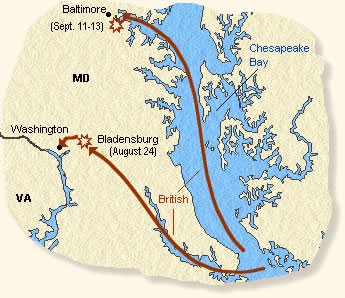
August of 1814 was one of the hottest in the memory of the approximately 8,000 residents of America's new capital. The sweltering, humid heat turned the stagnate marshes surrounding the city into thriving hatcheries for disease-carrying mosquitoes. To make matters worse, the city found itself the target of an invading British army slowly making its way from the Chesapeake Bay.

America had been at war with the British Empire since 1812, but the action so far had consisted of a series of indeterminate skirmishes along the Great Lakes region. With the defeat of Napoleon, the Empire turned its full attention to its former colony sending its battle-hardened troops to squash the up-start Americans. Washington had little strategic value - the thriving port of Baltimore was much more important. However, as capital of the nation, the British hoped that its burning would have a psychological impact on the will of the Americans to continue the conflict.

As the British army of approximately 4,000 approached, the majority of Washington residents fled the city. On August 24th American defenders, with President James Madison in attendance, were quickly routed by the invaders in a battle at Blandesburg a few miles from the city. A messenger was dispatched to the White House to warn First Lady Dolly Madison of the impeding arrival of the British. She and her staff fled by carriage across the Potomac - taking with her the full-length portrait of George Washington that had been torn from a White House wall.

That evening, the vanguard of the British army reached Capitol Hill and began its systematic destruction of all public buildings in the city. (reprinted from Eyewitness to History.com)

Now, on this day set aside for the Veterans of this country's wars, I would especially draw your attention to these. It is the really defining one in the history of this country, even more than all the other one's this country was subsequently drawn into in defence of "very much" European specific interests, particularly those of Britain. (Which is not to say that especially the Great War Against Fascism did not have important universal aspects.) Whereas this one, however, made necessary as a consequence of the developing notion in ruling US circles, of what they called their Manifest Destiny to govern the entire North American continent, is that war which made a Canada even possible, by defending it against the first US invasion of Canada begun in 1812 and ending in 1814 with the burning of Washington D.C. ,

And though this Manifest Destiny concept of the US Empire that has since grown up to replace the old British Empire is still very much with us, and now extended itself to the entire world, and grown even much more dangerous, and poses its danger still to this country along many fronts. economic and political as well as military, it is important that we remember that it is far from infallible and unbeatable. The Veterans of this war of 1812 to 1814 defeated them once, and now come down to us as a legacy worth remembering and taking pride in. It is part of the history of this country, and the continent.

It is important that we honour the memory of the veterans of this war. For it is a primary historical event, probably most important in the history of this country, which still speaks to us today-, if we are paying attention.

The War in Outline (From Wikipedia)

Background

At the time, Washington was a minor port with only about 8,000 inhabitants — about 1,300 of whom were slaves. What it lacked in strategic value, however, it made up in symbolic value. The British and Canadians sought revenge on the United States for the destruction they had caused on the capital of Upper Canada (now Ontario) at York (now Toronto) after the Battle of York in 1813. Naval commander George Cockburn wrote that he hoped the destruction of the new republic's capital might demoralize the enemy as well.

On Wednesday, August 24, 1814, British General Robert Ross defeated the American forces at the Battle of Bladensburg, laying open the path to the capital. Ross had landed in Maryland after the Peninsular War had ended, as part of a three-way invasion scheme by the British aimed at Baltimore, New Orleans, and New York.

During the American retreat, President James Madison sought out Secretary of War John Armstrong to see what the plan was for the defense of the capital. Armstrong reported that there was none; he had expected the British to turn next to Baltimore. The President, his cabinet and many other government officials fled to the mountains of Virginia. Most residents of Washington had already abandoned the city; preservation of the government's documents and records had been largely left to clerks and slaves.

Occupation and burning

On August 25, the advance guard of British troops marched to Capitol Hill; they were too few in number to occupy the city, so Ross intended to destroy as much of it as possible. He sent a party under a flag of truce to agree to terms, but they were attacked by partisans from a house at the corner of Maryland Avenue, Constitution Avenue, and Second Street NE. This was to be the only resistance the soldiers met. The house was burned, but the soldiers were infuriated, and the Union Flag was raised above Washington.

The buildings housing the Senate and House of Representatives — construction on the trademark central rotunda of the Capitol had not yet begun — were set ablaze not long after. The interiors of both buildings, including the Library of Congress, were destroyed, although the thick walls and a torrential rainfall preserved their exteriors. (Thomas Jefferson later sold his library to the government to restock the Library of Congress, and British Prime Minister Tony Blair apologized for the burning of the Library of Congress 189 years later on July 17, 2003[1]). The next day Admiral Cockburn entered the building of the D.C newpaper, National Intelligencer, intending to burn it down; however, a group of neighborhood women persuaded him not to because they were afraid the fire would spread to their neighboring houses. Cockburn wanted to destroy the newspaper because they had written so many negative items about him, branding him as "The Ruffian." Instead he ordered his troops to tear the building down brick by brick making sure that they destroyed all the "C" type so that no more pieces mentioning his name could be printed.

The troops then turned north down Pennsylvania Avenue toward the President's House. First Lady Dolley Madison remained there after many of the government officials — and her own bodyguard — had already left, gathering valuables, documents and other items of importance, notably the Lansdowne Portrait, a full-length painting of George Washington by Gilbert Stuart. She was finally persuaded to leave moments before British soldiers entered the building. Once inside, the soldiers found the dining hall set for a dinner for 40 people. After eating all the food they took souvenirs then set the building on fire.

Fuel was added to the fires that night to ensure they would continue burning into the next day; the flames were reportedly visible as far away as Baltimore and the Patuxent River.

The British also burned the United States Treasury building and other public buildings. The historic Washington Navy Yard, founded by Thomas Jefferson and the first federal installation in the United States, was burned by the Americans to prevent capture of stores and ammunition, as well as the 44-gun frigate Columbia which was then being built. The United States Patent Office building was saved by the efforts of William Thornton—architect of the Capitol and then superintendent of patents—who convinced the British of the importance of its preservation.

During the occupation, a hurricane which included a tornado passed through, damaging both the invaders and the city, but it quickly dissipated and helped put out the fires.[2] The occupation of Washington lasted about 26 hours, and within a week the British troops were dispatched to their next target, Baltimore. President Madison and the rest of the government returned to the city but were in such disarray that they were unable to prosecute the war effectively.


Friday, November 10, 2006


A Man's Gotta Do...

Outside of simply just taking some mental health time, the Mrs and I are re-painting the kitchen, which means all the prep stuff of washing the walls and greasy cupboard tops and taping first, in order to get at that "citron yellow" which I'm so looking forwards to , to pop our white cupboards and new stainless steel and black trim appliances. And at our ages, it goes slower than it would have once, back in the mist of time. Then there's the back, the hips and the knees.... :-) LOL.

Anyway, I 'm following things as much as possible , and keeping up with the chatter.

I've been around "The Cause" too long now to abandon it for long.

"I shall return". , as that old reactionary "imperialist" US General MacArthur said upon his retreat from the Phillipines. Back when the US Empire was still in its ascendancy, rather than already upon its downhill skids.

Peace 'n flowers. :-)

Thursday, November 09, 2006

[Also appearing in Vive le Canada.]

The RCMP Raids on B.C. Legislature Offices (Dec. 28, 2003).

A Tide of Corruption. Second Part.
By Robin Mathews

Nothing can excuse B.C. Attorney General Wally Oppal. His comments about evidence in the Legislature Raids process (presently before the courts) are, quite simply, outrageous. Chatting "casually" (?) to reporters at the beginning of November, Oppal called into question wire-tapping procedures used before the raids. They were, as he spoke, being argued before a judge in Chambers.

The tide of corruption upon which the David Basi, Bob Virk, and Aneal Basi legal procedure floats is highlighted by Oppal's unacceptable intervention. In a legal hotchpotch such as this one, in which cabinet employees are under charge - one from the office of a former Attorney General - prudence should dictate silence on the part of Wally Oppal. The position he holds is always a highly sensitive one whatever the situation, for "the highest law officer of the Crown" is also an elected politician sitting in cabinet meetings in which many participants - in this government especially - may be working to defeat the ideals of justice.

We mustn't forget that the Attorney General of the day, in 2003, Gary Collins, employed one of the men charged following the legislature raids. Nor should we forget that Collins - apparently approaching the height of his political career - chose to drop out of politics shortly afterwards. We do not seem to be fortunate in the Attorneys General we get with Gordon Campbell as premier.

It may be fair to say that no one in the present government is happy to see the trial going ahead. For even if elected officials escape untouched, public opinion will wonder at the miracle. It may be fair to say, too, that the men charged are not likely to be happy to see the trial going ahead, for obvious reasons. In this trial, the government of the day and the members of cabinet connected to legal functions cannot be objective or eager to see justice done.

That makes Wally Oppal's comments doubly offensive. And they point toward the argument that may destroy the case. Is Oppal preparing the ground innocently?

Why, then, is the trial being conducted? Because the Crown and the people want the process of legal action to work for the sake of democracy, justice, and the rule of law in British Columbia. But who, we have to ask, is the Crown in British Columbia?

Oppal, himself, "chief law officer of the Crown", breached the demands of dignity and prudence when he stepped from the Supreme Court into a Liberal Party candidacy. By doing so, he made a mockery of the absolute need for a clear separation to exist - and be seen to exist - between the politicians and the courts. He is a politician who was very recently a colleague of present Supreme Court judges, allowing no time to lapse between his resignation from the court and his assumption of a political role as a Liberal candidate, and now as Attorney General. Does he telephone his recent Supreme Court colleague, Madam Justice Elizabeth Bennett, who is conducting the court processes involving the men charged? Who knows?

Is there, moreover, a Gordon Campbell government agenda to undermine the courts and to cripple - for political reasons - the legal system in the Province? And, if so, is Wally Oppal assisting with that agenda?

Oppal recently attacked the Supreme Court judges about their working hours in words that Chief Justice Donald Brenner said "constitute a deliberate attempt to demean the judges of this court". (Ian Mulgrew, Vanc Sun Nov 1 06). The Campbell government, moreover, is accused - since May of 2002 - of closing courtrooms, consolidating or downgrading others, and laying off court workers and deputy sheriffs around the Province when municipalities are growing in size with the effect that larger and more reasonably accessible courts are, obviously, required. (BCGEU letter, Nanaimo Daily News Oct 13 06). Oppal has to be a supporting part of that agenda as a member of cabinet.

He is also named as one of the parties wanting the water power rights of British Columbians in the Nechako River stripped from them and granted to the foreign Private Corporation, Alcan. Clearly, against the interests of British Columbians, Oppal is working for the sleazy political ends of the government he serves (and of which he is a part).

British Columbians may well ask if they have a dangerous, partisan clown as their present Attorney General. As NDP MLA and lawyer Leonard Krog has said: "High profile prosecutions have failed in the past because politicians felt compelled to make comments in public that were later deemed prejudicial". (Media release, Nov 2)

The Crown in British Columbia does not have a distinguished presence, to say the least. Madam Justice Elizabeth Bennett, sitting on the Legislature Raids trial and hearings, was the judge in the long, long Glen Clark case. I have called for a full Royal Commission-level investigation into what I call the fraudulent investigation and trial of Glen Clark.

During the trial his counsel asked that the trial be named, in effect, vexatious, without merit, and ended. Justice Bennett refused, permitted an endless trial, and then declared that, in effect, the 29 volumes of evidentiary material, gathered over months and months by a dubious RCMP investigation, did not contain reason to believe Glen Clark was guilty of anything.

But - to the glee of the Gordon Campbell forces (the complaint against Glen Clark began in Gordon Campbell's constituency office) - Glen Clark was ruined and the NDP was savaged.

Madam Justice Elizabeth Bennett did not apologize to Glen Clark and to British Columbians for that. She said Glen Clark was innocent but was imprudent, and she slapped his wrist for his private associations when she should have apologized to him and suggested he seek remedy for the huge damage done to him and to the democratic life of British Columbia. It is almost as if she were working for the Gordon Campbell forces.

The judge who has kept much of the Legislature Raids material locked away from British Columbians is Associate Chief Justice Patrick Dohm. He issued search warrants in the Glen Clark case from a holiday spot somewhere in a foreign country. When a BCTV crew - in full readiness - arrived with the RCMP officers who had come to exercise a search warrant on Glen Clark's house, Mr. Dohm seemed unperturbed. He permitted the film of that event to be played over and over and over, depicting Glen Clark as if he were a fugitive from justice caught by the cameras.

Perhaps Patrick Dohm could not discipline BCTV for, somehow, finding out about and getting to that RCMP search. But he could have sealed the film footage. And he didn't. It is almost as if he were working for the Gordon Campbell forces.

Persistently, bullishly, and without any attempt to explain carefully and educationally to British Columbians his invasion of their right to know in the present case, Patrick Dohm locked up information "for the protection of the accused". I, for one, don't believe that explanation.

In the hearing, just over, the Application for Disclosure filed in Criminal Registry by the Defence counsel for Dave Basi, Bob Virk, and Aneal Basi, was denied to the public by Mr. Justice Patrick Dohm for, apparently, the protection of the accused. ALL such documents are denied to the public by Justice Dohm. In this case the Application for Disclosure records a fight among lawyers about evidence. That is all.

I went to Criminal Registry with a friend, early in the hearings, to obtain a copy of the Application. We were so rudely dismissed by a man who identified himself as Ian we asked to see the Directive refusing public access. It is, of course, a Directive from Mr. Justice Patrick Dohm and it directs blanket denial of public access to all such documents "to protect the accused" we were told.

I believe, rather, it is a gag order to protect the powerful against legitimate concerns of British Columbians. I say that because, otherwise, the Directive would be much more sensitive, providing a speedy screening mechanism to separate out only those rare and few instances in which information might be kept from the public (for the sake of persons' safety, etc.).

The next day my friend and I went back to Criminal Registry to inform the clerk, this time named Alpha, that Defence counsel had okayed release and was going to ask that I be shown the Application for Disclosure and some other documents. Alpha told us Criminal Registry does not answer to counsel but to Mr. Justice Patrick Dohm and would probably not do as counsel was going to request. Anyway, it would need clearance, she said. I gave my name, which she attached to her note on the matter.

To exaggerate the Patrick Dohm absurdity of Criminal Registry, a man materializes silently when people appear at Criminal registry who are as darkly suspicious and obviously lawless as my friend and me. The man sidles up to the counter, and he eavesdrops. For all I know he may then send a secret report - kept, of course, from the public - to Mr. Justice Patrick Dohm so the Associate Chief Justice of the Supreme Court of B.C. may use it. In the pursuit of justice, of course.

The next morning when I telephoned Criminal Registry, Ruth, who identified herself as in charge of the section, claimed to have seen no documents left for me (and they would have come to her, she said). She claimed to know nothing whatever. Alpha had told her nothing. Ruth had obviously not seen the note Alpha wrote. A total blank. So much for service to the people of British Columbia.

In my last column I called the event "Kafka'esque", "irrational". It is worse than that. For Mr. Justice Patrick Dohm scatters what I see as his capricious power without reason or logic. A member of the public or press may not get documents from the point of public access, the Criminal Registry of the Supreme Court. He or she is told that only active counsel may give documents. That means if counsel wishes to deny the public access to key information, it may. It means the public must leave the point of public access, search for counsel involved, and depend upon counsel's good will. It means counsel, which has definite interest in cases and their status, can provide documents - or deny them - to whomsoever it pleases. There is no objective agent which can provide, without bias or questions, materials that every Canadian has the right to receive.

It means, in short, that Mr. Justice Patrick Dohm presides over a system which is irrational, capricious, discriminatory, elitist, and unjust. It is almost as if he is working against the pursuit of justice in British Columbia and against the goals of a democratic society.

The "Crown" in the actions which have brought the Legislature Raids trial this far is a very weak reed. The question that must be before British Columbians is whether that weak reed is strong enough to stage the trial to completion and to see that justice is truly done.

_________________________________________________________